October 27, 2008

Palestine's New Soccer Home: Political Building Block or Temporary Distraction?

As an international soccer friendly came to a close on Sunday, resulting in a 1-1 tie between the 180th ranked team and the 112th ranked team, one had to wonder why FIFA president Joseph (Sepp) Blatter was smiling and cheering alongside the rest of the six thousand frenzied fans in attendance. For Blatter, the outcome of the match between Palestine and Jordan mattered very little. Instead, as the General Association of International Sports Federations reports, he was content to celebrate the significance of the first-ever Palestinian home game (pictured below), describing the event as "a historic moment and a victory for football." Of course, the day meant much more than the initiation of a long overdue stadium for a nation that has been a member of FIFA since 1998. Given the abundance of political tension in the area over the past decade, Sunday's match provided fans with a rare opportunity to express their national pride with unbridled optimism. The PA announcer belted cheers such as "football is more noble than war," while Blatter effectively endorsed Palestinian political aspirations, echoing that, "football is hope for politicians to reach the goal." Certainly, a new soccer stadium will not fix the seemingly unsolvable land dispute with Israel, but for many, such as Palestinian Football Association (PFA) President and former national security adviser Jibril Rajoub, the occasion marked an opportunity to politicize the determination and unity of the Palestinian people. As the Reuters Soccer Blog notes, Rajoub's insistence on referring to Jerusalem as the location of the new stadium, rather than the town Ram (as stated by FIFA), was in many ways a "statement about nationhood, sovereignty, and identity that goes to the heart of the Middle East Conflict."

Certainly, this momentous occasion is a symbol of hope for the future, but it is important not to blow its effects out of proportion. Although many, such as thirty-nine year old Hiyam al Wahwah, are encouraged that "things will really change and that [they] can live like any other people," circumstances may signal otherwise. The hostility between Israel and Hamas, which controls Gaza, has led Israel to impose severe rules and regulations that greatly restrict travel to and from the area. Consequently, Palestinian soccer players from the area have often been unable to attend training sessions, practices, and even games abroad. In fact, team captain Saeb Jundiyeh missed the historic game because he was not allowed to travel to the West Bank. Earlier this year, moreover, the entire team failed to show for a World Cup qualifying match in Singapore, claiming that the eighteen members of the team based in Gaza did not receive Israeli permits to leave. Even the excitement surrounding the new stadium is somewhat stifled when one needs to look only yards beyond the stadium to notice what one blogger calls "Israel's apartheid wall." Such issues are bound to persist if violence continues to dominate the region, as it has since Hamas's aggressive seizure of the Gaza strip (pictured below, right). Fairly or unfairly, Israel's travel restrictions are essentially a form of national security, which inevitably takes precedence over complaints relating to soccer matches.

However, the emergence of a home soccer stadium has provided a renewed sense of nationalism, something that cannot be understated. Certainly, the people understand that the conflict will not end overnight and that the forces of soccer cannot produce an internationally recognized Palestinian state;
still, every piece of the puzzle, small or large, is an important stepping stone, a necessary building block. As fifty-year old soccer fan Suleiman al-Suhairi pronounced, "this shows the world that we are capable of hosting a major sporting event and that our people aspire to live a normal life despite the occupation." Rajoub goes even further, asserting that the new stadium establishes that "Israeli occupation, the closures, and the difficult living conditions have not defeated the determination of the Palestinian people." Indeed, the remodeling of a national institution has, at the least, reemphasized a unity among Palestinians that has been rare in recent years. Before the game, for example, senior Hamas leader Ismail Haniya actually called Rajoub, a former leader of the secular Fatah party, in order to wish the team luck. Such an occurrence by no means signifies that the two opposing political parties will reconcile their differences to form a united front, but as mentioned above, every small step counts during times of hardship. Still, questions linger regarding what to do next. It remains to be seen if the current optimism will remain on the rise or begin to drop off as the remodeled stadium becomes old news. Perhaps the One Voice peace movement has the right idea in its proposal for Israel/Palestine to host the 2018 World Cup. Such a move would not only force the two sides to coordinate together, but would also bring in players and media from around the world, shining an international spotlight on the region. Practically speaking, however, this proposition remains idealistic and improbable. Again, there appears to be no easy solution in sight, but at the least, the reemergence of soccer in Palestine should provide temporary reprieve to the difficulties of the current conflict.

October 14, 2008

The World of Sports: An Exploration of Online Sports Resources

This week, I decided to probe the vast resources of the World Wide Web in search of dynamic and distinguished web sites, including organizations, news sources, and blogs that I believe will not only serve the interests of my readers, but will complement the content that I provide in my postings. In order to ensure the utility of these sites, I applied Webby and IMSA criteria for evaluating blogs and websites, which led me to the discovery of twenty fine websites based on content, structure, visual design, functionality, interactivity, authority, and depth. I began with ESPN, widely considered the best source for sports news. It is a beautifully designed site, functions smoothly, and allows the visitor to easily interact with the contributors of the site. However, it is only useful for surface level stories, and as such, is generally beneficial solely for a quick search. I then unearthed several key organizations and associations that pertain directly to a few of the key international aspects of my entries, such as UEFA (European Soccer League), FIBA (International Basketball Federation, pictured right), and the IOC (International Olympic Committee). I found each of these sites to be authoritative, extremely well organized, and navigable, while effectively attaching both audio and video clips. They are, however, prone to become cluttered with small blurbs regarding scores of games rather than with in-depth news stories. Similarly, the ICC (International Cricket Council) suffers from the same flaw, although easy access to its news archives allows the visitor to quickly uncover relevant information. The final two international organizations that I linked to, the Institute for International Sport and the General Association of International Sport Federations, are both helpful sites, specifically by exploring a wide variety of content. However, like many of the other organizations and associations, they demonstrate very little interactivity and are often muddled by news stories that are consumed by insignificant updates and announcements.

As noted, organizations are often restricted by their intent to serve merely as a reference website than a vibrant news site; thus, their limited interactivity and content is unsurprising. In contrast, World News Network Sports serves nearly all of the criteria for an effective site. It has a massive breadth and depth of content, is easy to navigate, and is visually appealing. It is particularly applicable because of its links to an assortment of sports and non-sports sites, and even exhibits a feature that allows the visitor to submit his/her own videos or photos. An offset of this site, Africa Sports News, reveals a similar interface and expresses more in-depth news, making it a useful source that was helpful to me in my first post concerning exploitation in African soccer. Also beneficial to my initial entry was the World Cup 2010 South Africa site, which is not only visually pleasing, but produces various tidbits of soccer information that frequently explore the off-the-field aspect of the game, which is of precise importance to my blog. Another site that attacks a specific to one aspect of international sports is Light the Torch, a blog that is devoted to all Olympics, all the time. Light the Torch is a masterful production of posts that concern Olympic issues instead of simply Olympic results. It is also easy to locate past entries as well as relevant links to other reputable sites. However, the blog is also littered with advertisements that visually offset many of its positive features. The well-renowned International Herald Tribune's Sports Blog is also organized nicely, and supplies a broader view of the sporting world, however, it focuses distinctly on the sports-related news stories, and exhibits little regard for international significance. The Tribune could take some lessons from PRI's The World Global Sports Blog, which effectively provides international stories, from soccer in China to rugby in South Africa. Yet, for all of its valuable content, it is visually quite bare, doing little to entice the visitor to explore the site. Similarly, the Globetrotting Blog benefits from the outstanding reputation of its author, Philip Hersh from the Chicago Tribune, who has been recognized as one of one hundred most influential people in world sports. As a result, his contributions are lively and significant, although, like PRI's blog, the Globetrotting Blog suffers from a lack of visual aid, and an uninspiring interface.

The most significant flaw in almost all of the links mentioned thus far is the lack of depth. In other words, most of the previous sources concentrate directly sports, albeit internationally. With the next several links, however, I aim to present sources that investigate the various aspects of international sports, such as sports law and sports business (pictured left). Globalex, an NYU Law-based guide to international sports law, efficiently illuminates the legal aspect of sports, although it offers zero interactivity, and fails to provide updated information at all. A more effective site, the Sports Law Blog, offers views from several knowledgeable contributors and offers new entries almost daily. It is not the most visually appealing site, but it is structured nicely and is quite easy to navigate. Another blog, titled Money Players, appeals to the business side of sports, from high school to the professional leagues. Unfortunately, it is rarely updated, and often goes off subject, although it occasionally posts further links to other sites that are generally helpful. Along the same lines, the Blog of Sports Business is well organized, despite its complete lack of visual aids, such as photos or videos. Yet again, this blog also suffers from a deficiency of new entries; the site indicates it returned from a hiatus on October 9, just five days ago. Perhaps the most noteworthy sports business site is Sports Business International, which delves into the international aspect while demonstrating a visually pleasing interface and attaching relevant news stories, updated daily. Indeed, the lack of an outlet for participation on the site is its only notable flaw. Finally, I linked to the Elias Sports Bureau, which is the most highly-regarded sports records site on the Web. This site is for reference only, and is not a news outlet in any way. Nevertheless, it is a very useful tool for those who wish to learn more about a player or a team that is part of the topic of discussion, specifically in regards to statistics. Certainly, these are only some of the incredible resources on the Web, but I believe that these twenty are extremely valuable, and will be beneficial to anyone interested in international sports.


September 30, 2008

The Future of the NBA: International Expansion

Last week, I chose to examine a disturbing and recurring story that illuminated the exploitation of young and talented African soccer players. In doing so, I discovered that while the situation has been dismal and unsolvable for years, some prominent players and organizations were finally beginning to take positive steps in the right direction. This week, however, I found it impossible to ignore the current economic crisis, specifically that the House had rejected the Bush administration's bailout plan. As a result, I decided to attempt to relate the situation to the sports world, and was able to do so through recent news regarding the NBA's international expansion. With such an economic downturn, it seems clear that the NBA must renew its efforts to increase international marketing, with the goal of eventual expansion. As the crisis begins to seep down to the people, spending on luxury items such as basketball tickets is sure to fall, leading the NBA to look elsewhere for revenue, such as television markets. Following the vast successes of the Beijing Olympics, moreover, interest in the NBA is rapidly increasing (pictured left), especially in China, where the NBA is already immensely popular. It follows, then, that the 2012 Olympics in London should provide another spectacular venue and hopefully demonstrate the virtues of the NBA to British citizens, creating a fresh, new market for television and merchandise sales. In considering this pertinent topic, I encountered and commented on two different blogs. The first post that I responded to, "Basketball Goes All Out to Score in the UK," was written by Shakthi Kumar from Chennai, India, who creates multiple entries daily in his blog, "Basketball Updates, History, and Recaps." In his entry, he examines the attempts of the NBA to win over England as new market source of revenue. The second post that I responded to, "U.S. is Likely to Win Gold, but the NBA is the Big Winner," by Bob Kravitz, a well-renowned sports columnist for the Indianapolis Star since 2000, focused instead on the developments of NBA marketing in China, a nation where NBA support is expected to continue to grow. In addition to publishing my comments directly on the authors' respective blogs, I have also posted these comments below.

"Basketball Goes All Out to Score in the UK"
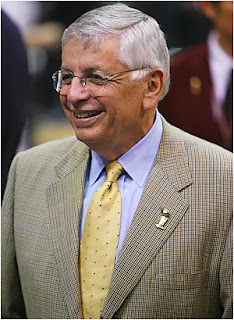
I would like to thank you for a thoughtful and provocative post regarding the changing dynamics of the NBA, specifically regarding its attempts to increase its popularity in new markets. You have clearly researched the subject, providing pertinent examples of the way in which Commissioner Stern (below, right) and the NBA are trying to implement their product overseas. I was impressed with the way in which you approached the subject, by first contrasting the international expansion of the English Premier League with the international expansion of the NBA. I find it interesting that of the NBA's annual $600 million revenue overseas, the UK provides such a small proportion. I understand that most/all of the sports attention is focused on the Premier League, but I am surprised that basketball "has failed to capture the public's imagination," when it seems to be quickly increasing in popularity in other parts of Europe, including places where soccer is prominent as well. I wonder if you have any further thoughts on the subject? In any case, I certainly agree with you, then, that the upcoming 2012 Olympic Games in London will be the greatest opportunity for Commissioner Stern to attract a following for the sport. It undoubtedly seemed to be effective during the Beijing Games, although China has certainly had an NBA following for quite some time, including a marketable star of their own in Yao Ming. I was actually surprised to learn that there had been prior attempts to implement basketball into Britain's consciousness, although I suppose such attempts were not well publicized because of their failures. What really piqued my interest in this post, however, was the latter portion, in which you cite Stern's concerns regarding the current economic crisis, which, as I'm sure you know, has taken a turn for the worse today, with the House's rejection of the bailout plan. Clearly, sports are not the primary area of concern with regards to the crisis, but it is interesting to consider that if/when ticket sales are adversely affected; expanding television markets will become more of a necessity than a desire. Obviously, Britain would provide a very large market, both for television and for merchandise sales, depending on whether or not the upcoming Heat-Nets game has some success in stirring interest. I wonder, however, if you have considered that while the economic crisis will force Stern to expand markets, it will likely also have a negative effect in the British economy, consequently making it difficult for basketball, a new form of "luxury spending," to gain any traction.

"U.S. is Likely to Win Gold, but the NBA is the Big Winner"
I first want to thank you for your insightful post regarding the future of international basketball. It is clear, as you stated, that the development of the NBA is heading in the direction of foreign markets, none of which are bigger or more prepared for the big stage than the nation that just finished hosting the biggest basketball tournament in the world. While it was important on many levels for the US to come away from these Olympics with a gold medal, I completely agree with you that the more important result was the increased exposure of NBA stars to an emerging market. Most notably, the Chinese market is, as you explain, experiencing unprecedented growth, leading to a situation in which "the Chinese are looking at the NBA product as a way to spend their increasing reserves of disposable income." This important characteristic, combined with the exponentially growing interest in the sport (as you illustrate with NBA.com/China as the most popular sports site in China) and the recent creation of NBA China, demonstrate the inevitability of increased NBA exposure in the market. However, I am somewhat hesitant regarding your prediction that within ten years the NBA will have a franchise in China, as well potential franchises across Europe. Of course, the last decade signified an incredible increase in the foreign talent pool, especially when considering it has been eight years since the US took Olympic Gold. Indeed, international interest in the game is rapidly increasing. Still, the NBA has yet to play a regular season game abroad, much less consider the notion of adding a team. The traveling expenses would not only be substantial, but there would also be many players unhappy with their new arrangements, having to travel tens of hours between games, not to mention having to adapt to foreign cultures. Additionally, it seems that with the recent depreciation of the dollar relative to the Euro, the NBA will have a hard enough time as it is trying to compete with European leagues for players, as we have seen with the recent departures of Josh Childress and Carlos Delfino, among others. Moreover, superstars such as LeBron and Kobe have seriously entertained the idea of leaving for Europe for at least one season, based on rumors of $50 million offers. With the advent of the current economic crisis, it is more important than ever for the NBA to expand its markets abroad, and I agree with you that the Olympics have done so quite effectively. I remain, however, skeptical of the speed with which a worldwide league could be created.

September 23, 2008

Europe's Quest for Soccer Success: A New Wave of Exploitation

For years, developing nations have relied on the exports of their most precious resources, such as gold, silver, and oil, in order to survive economically. Through this process, they have developed a dependency on the powers of the world, relying on them to infuse capital into their struggling economies in exchange for such resources. Nowhere is this form of post-colonial exploitation more evident than in Africa, where scarce resources abound and poverty is rampant. Today, however, there exists a new commodity to exploit: young, talented soccer players. There are several African soccer leagues, but none can compare to the profitability of European leagues, and as a result, African youths grow up with the dream of playing for the top European clubs, where they imagine they can make inordinate sums of money to send back to their families. This dream, however, provides a niche for profit-seeking businessmen to swoop in, taking kids as young as twelve from their homes with the often false promise of success in Europe. While some players buck the trend and become European stars, the majority of them fail, their profit value plummets, and they are subsequently abandoned, left to drift in a foreign country embarrassed that they failed to fulfill their family's dream.

Of course, the flip side of the argument is that these 'agents' provide the opportunity for kids in a situation in which they have no other options; that is, at least they are given a chance to go make money for their families. Clearly, there are those who eventually succeed with European clubs; however, as the Irish Independent News reports, even the most successful African players have a problem with the current system. Nwankwo Kanu (pictured left), Portsmouth's Nigerian center-forward, has twice been African player of the year, won the European Cup, and won an Olympic gold medal; yet, he still takes issue with "agents who have for years preyed on young African players, ripping them off and leaving many penniless and abandoned."

Regrettably, the exploitation does not end even for those who are fortunate enough to sign contracts with European clubs. Georges Mojado of Cameroon began playing for the Belgian club team RAEC Mons when the minimum wage was 1,075 euros per month. He received 150 euros instead, less than 15% of the 'minimum' wage. Timothee Atouba, also of Cameroon, was paid only 1/3 of his promised salary from Neuchatel Xamax of the Swiss League, and his complaints regarding his income were met with threats to send him back to Cameroon. Moreover, players of African descent are often subjected to racism during matches, an epidemic that may be growing rather than receding.

Still, there are marginal benefits to the continent-wide talent search. In Qatar, for example, the government-funded Aspire Sports Academy (pictured below) has begun providing scholarships and elite training facilities to those (ages 12 and up) who make it through the final round of competition, many of which are young Africans that would not otherwise have such an opportunity. However, the growing concern is that there are few social safety nets; in other words, for those who do not make the final cut, unknown instability is likely to follow. Further, concern has been raised in regards to the overarching goals of this massive recruitment; specifically, some believe that the talent search is solely a means for Qatar to enhance its national teams. This worry is not unfounded, considering that Aspire officials will own the players' rights once they become eligible to play professionally.

Finding a suitable answer to the debate will be difficult. On the one hand, one would be hard-pressed to take issue with the endowment of scholarships to poverty-stricken kids. On the other hand, the use of these players for commercial and national gain is naturally exploitative. On a larger scale, moreover, African countries are losing out on the possibility of economic prosperity. In Europe, soccer clubs make enormous margins of profit, by virtue of both ticket sales and corporate sponsorships, which allows them to offer large contracts. In Africa, however, the lack of capital creates a vicious cycle. Players have no opportunity for economic prosperity within the continent because the clubs do not possess the necessary capital to compete with Europe for star players. As a result, the lack of talent on the clubs piques little interest both nationally and abroad, leading to a lack of both ticket sales and corporate sponsorship.

There appears to be no easy solution. Yet, there is hope. African star Nwankwo Kanu (mentioned above) is setting the standard for fixing the system with his new Kanu Football Foundation. Established in May, the organization hopes to follow in the successful footsteps of his first foundation, the Kanu Heart Foundation, by providing help and advice to young soccer players and their families free of charge. Furthermore, says Kanu, the foundation will aim to set up academies across the continent, including countries such as Ghana, Nigeria, Sierra Leone, Uganda, and Somalia, in order to provide a better education and more opportunities locally. While Kanu is realistic about the unlikely prospect of stars staying to play locally in the near future, ("where there is no money, people don't want to stay"), he is optimistic about the potential for change. "I hope the foundation will advise leagues and associations on how to improve," he says. "We do have to find local stars for local leagues so that people can aspire to be them also."

FIFA (French for International Federation of Association Football) has joined in the movement towards change as well, investing heavily in its 'Goal' Project over the last several years, aimed at improving African domestic leagues. Significant change, however, must come from within, and Kanu has taken the first step in that direction. Ending the exploitation may not be easy or quick, but at least there is hope that with hard work, it can happen.
 
Creative Commons License
This work is licensed under a Creative Commons Attribution-Noncommercial-No Derivative Works 3.0 Unported License.